

DeepSeek-V4-Flash Production API Public Beta
Introduction
As of today (July 31, 2026), DeepSeek has officially launched the public beta of the DeepSeek-V4-Flash production API. It’s been about three months since the V4 preview release on April 24 – and this update boils down to one key phrase: a massive leap in Agent capabilities.
DeepSeek has directly published results from nine benchmarks, with multiple metrics significantly surpassing the previous V4-Pro-Preview. You could even say it’s “punching above its weight” – reminiscent of the original V4 release that turned the hierarchy on its head.
A Quick Recap of the V4 Series
On April 24, 2026, DeepSeek dropped the V4 series unannounced, with two versions: Pro and Flash.
| Comparison | V4-Pro | V4-Flash |
|---|---|---|
| Total Parameters | 1.6T | 284B |
| Active Parameters | 49B | 13B |
| Architecture | MoE | MoE |
| Context | 1M tokens | 1M tokens |
| Max Output | 384K tokens | 384K tokens |
Pro is designed for maximum performance, going head‑to‑head with closed‑source flagship models. Flash, on the other hand, is much smaller in parameter count, trading size for lower latency and cost – all about cost‑effectiveness. What’s interesting is that this production Flash now pushes Agent capabilities even beyond the preview Pro – despite having roughly an order of magnitude fewer parameters.
Nine Benchmark Results
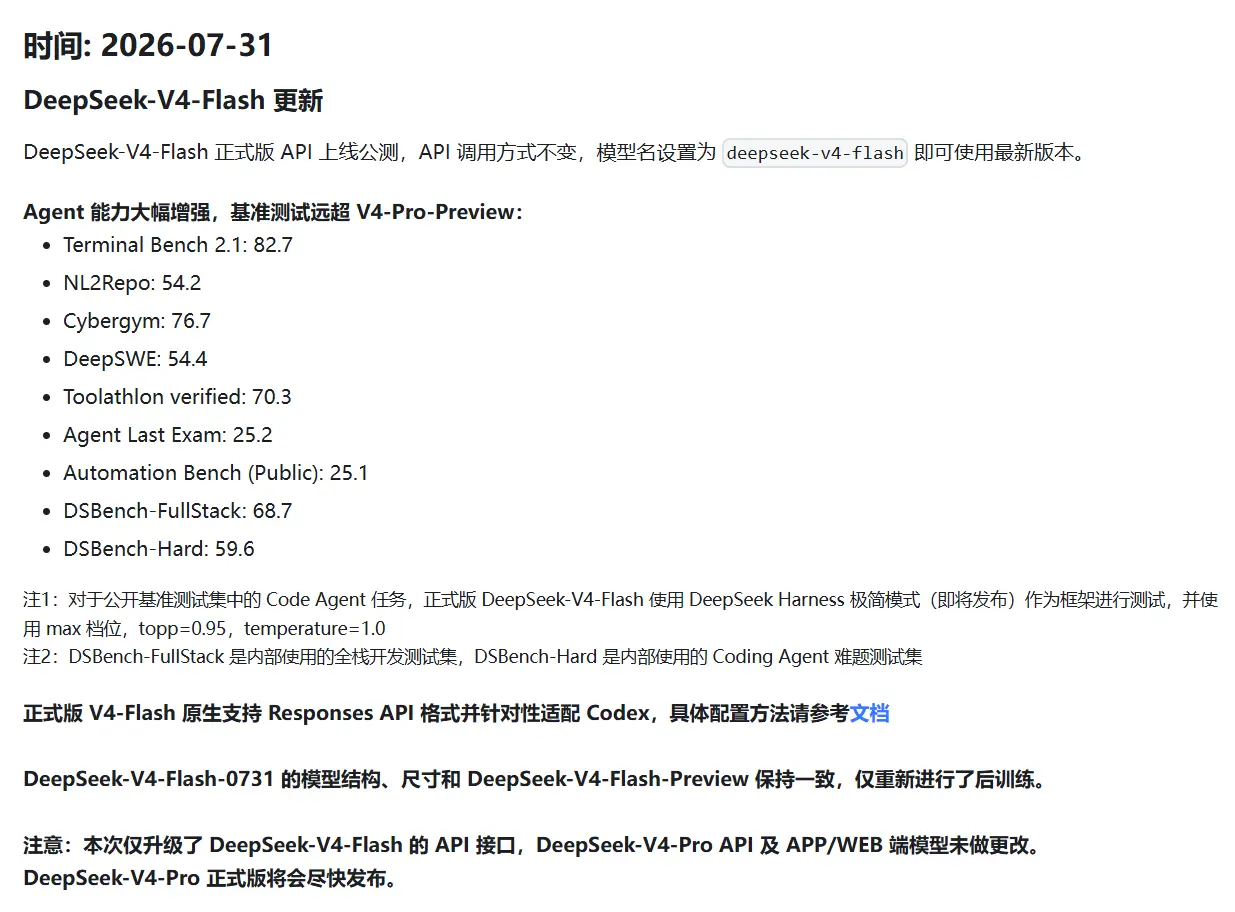
Here are the full results from the official changelog:
| Benchmark | Score |
|---|---|
| Terminal Bench 2.1 | 82.7 |
| NL2Repo | 54.2 |
| Cybergym | 76.7 |
| DeepSWE | 54.4 |
| Toolathlon Verified | 70.3 |
| Agent Last Exam | 25.2 |
| Automation Bench (Public) | 25.1 |
| DSBench-FullStack (internal) | 68.7 |
| DSBench-Hard (internal) | 59.6 |
A few things worth highlighting:
- Terminal Bench 2.1 scored 82.7 – DeepSeek previously reported V4-Pro-Preview at 67.9 on Terminal Bench 2.0. While 2.0 and 2.1 aren’t directly comparable, it’s still impressive for a lightweight model with only 13B active parameters.
- Cybergym at 76.7 – a cybersecurity attack/defence simulation test, showing solid performance in security‑adversarial scenarios.
- DSBench-FullStack and DSBench-Hard are internal test sets for full‑stack development and hard Coding Agent tasks. Publishing internal benchmarks signals DeepSeek’s intention to position Flash as the go‑to foundation for developers and Agent applications.
The official disclosure also noted that for the public‑benchmark Code Agent tasks, they used the upcoming DeepSeek Harness minimal mode as the testing framework, with max sampling, top_p=0.95, and temperature=1.0. Worth noting that this is the first time DeepSeek has officially named its own Harness testing framework – suggesting they’re not just building stronger models, but also aiming to establish a standardised Agent evaluation ecosystem.
Same Model Architecture, Stronger Performance
The official statement is clear: The model architecture and size of DeepSeek-V4-Flash-0731 remain identical to V4-Flash‑preview – only the post‑training has been redone.
The base model hasn’t changed – what’s changed is the training methodology. This sends a clear signal: in the Agent capability race, there’s still enormous room for improvement through post‑training strategies. Even with the same architecture, finer post‑training tuning can produce qualitative leaps in benchmark performance – which is more instructive for the industry than simply stacking more parameters.
It’s also worth mentioning that the V4 series has made aggressive optimisations for long‑context efficiency. In 1M‑token scenarios, Flash’s per‑token inference cost is only about 10% of V3.2, and KV Cache usage has dropped significantly – long context is no longer a “luxury for the wealthy.” This is one of the reasons Flash can keep its pricing so low.
Native Responses API Support with Codex Adaptation
The production V4-Flash natively supports OpenAI’s Responses API format and is specifically adapted for Codex.
All Codex clients – Codex CLI, ChatGPT desktop, and the VS Code Codex plugin – share the same configuration file. One configuration applies to all of them. DeepSeek also provides a one‑line PowerShell auto‑setup script:
irm https://cdn.deepseek.com/api-docs/codex-deepseek-setup-en.ps1 | iexThe script automatically backs up existing configs, writes to the models.json model registry (declaring context windows, inference tiers, tool call formats, etc.), modifies config.toml, and validates syntax before writing back – aborting if anything goes wrong. Pretty reliable.
One thing to note: currently only deepseek-v4-flash supports Codex integration; V4-Pro is expected to gain support in early August.
Pricing
Flash continues its value‑for‑money approach. Official pricing (per million tokens, off‑peak):
| Item | Off‑Peak Price | Peak Price |
|---|---|---|
| Input (cache hit) | 0.02 CNY | 0.04 CNY |
| Input (cache miss) | 1 CNY | 2 CNY |
| Output | 2 CNY | 4 CNY |
| Concurrency Limit | 2500 | - |
Compared to V4-Pro (off‑peak input cache hit 0.025 CNY, cache miss 3 CNY, output 6 CNY), Flash’s cost advantage is clear – especially with the generous 2500 concurrency limit for high‑throughput scenarios.
Peak/Off‑Peak Pricing
The V4 series also introduces an interesting mechanism: time‑of‑use pricing, essentially bringing electricity market logic to compute:
- Peak hours: Weekdays, Beijing time 9:00‑12:00 and 14:00‑18:00 (7 hours per day)
- Off‑peak hours: The remaining 17 hours, plus weekends and public holidays
All pricing doubles during peak hours – think of it as a “meter” on your tokens. Since the GPT‑3 era, large‑model API pricing has been flat‑rate; DeepSeek is the first in the industry to try this.
Two important details:
- This only applies to developer API calls – C‑端 users on the App/Web interface see no price change
- Off‑peak pricing matches previous rates – it’s not a “discount” after a price hike. The peak premium buys you priority compute access
For developers, this opens up cost‑saving strategies: data cleaning, document summarisation, offline batch processing – tasks that don’t need real‑time responses – can be shifted to nights or weekends to cut costs in half. For real‑time Agents, online customer service, and other peak‑sensitive scenarios, you’ll need to optimise prompt length and caching to keep costs down. And with cache‑hit input pricing as low as 0.02 CNY per million tokens, caching your system prompts and knowledge‑base prefixes can further reduce spend.
Upgrade Scope
It’s important to note that this upgrade only covers the V4-Flash API:
- Updated: DeepSeek-V4-Flash API
- Not updated: DeepSeek-V4-Pro API
- Not updated: App / Web model endpoints
- Coming soon: DeepSeek-V4-Pro production release (official says “as soon as possible” – rumoured for early August)
So if you’re using the DeepSeek App or web interface, you won’t notice any difference today. Also, the old deepseek-chat and deepseek-reasoner model names were deprecated on July 24 – they now map to deepseek-v4-flash in non‑thinking and thinking modes, respectively.