

EdgeOne vs ESA – How Strong Is EdgeOne, What's the Difference, and Which One Should You Choose?
Product Positioning and Background
Edge security acceleration platforms are the next evolution of traditional CDN products. They integrate static acceleration, dynamic full-site acceleration, WAF (Web Application Firewall), DDoS mitigation, bot risk management, edge computing, and more – all unified under a single site-based management model. This contrasts with traditional setups where CDN and security products are separate, requiring multi-console operations. Both Tencent Cloud EdgeOne and Alibaba Cloud ESA belong to this category, positioning themselves as competitors to Cloudflare.
Tencent Cloud EdgeOne (EO)
EdgeOne was officially launched in 2023, evolving from Tencent’s SCDN product. Its core feature is site-based management – once you add a site, all subdomains are automatically covered without needing to configure each domain individually or repeatedly maintain SSL certificates. It is Tencent Cloud’s next-generation flagship CDN product, officially positioned as a Cloudflare competitor.
Alibaba Cloud ESA
ESA stands for Edge Security Acceleration, rebranded and rebuilt from the original DCDN (Dynamic Content Delivery Network) product in 2024. In the DCDN era, static and dynamic acceleration capabilities were independent; ESA consolidates them while strengthening native security modules. The API version 2024-09-10 indicates a major architectural overhaul.
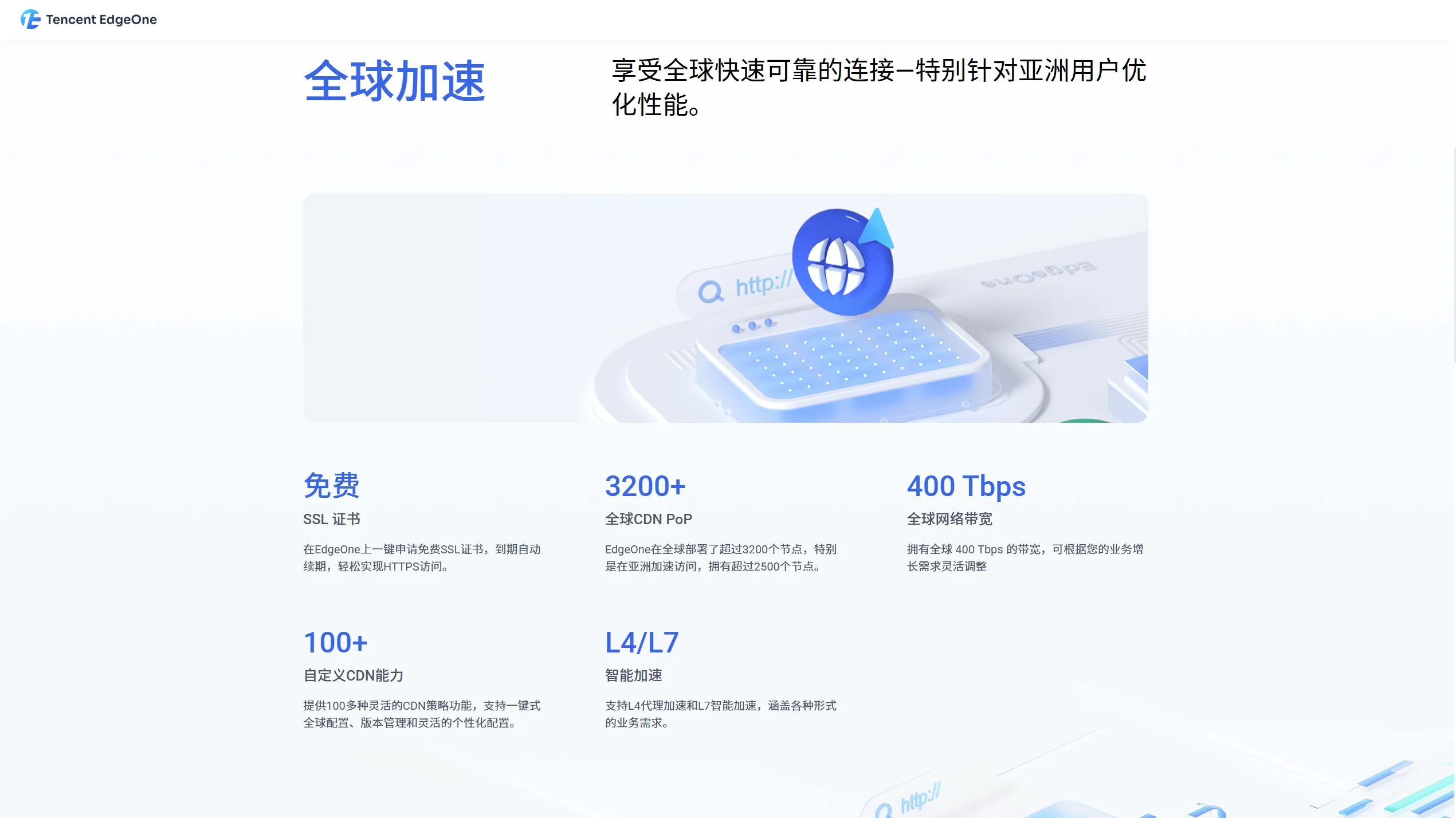
Both vendors claim 3200+ global nodes, with 2300+ nodes in mainland China. These figures should be taken as a reference – actual node quality and routing logic should be verified through real-world testing. Both have top-tier domestic node coverage in China, significantly outperforming many overseas vendors that claim “global nodes” but lack actual domestic resources.
Free Tier Comparison
The table below summarises the core specifications of each product’s free tier:
| Feature | Tencent Cloud EdgeOne Free | Alibaba Cloud ESA Free |
|---|---|---|
| Price | 0 CNY/month | 0 CNY/month |
| Traffic | Unlimited | Unlimited |
| Requests | Unlimited | Unlimited |
| Validity | Permanent (as long as site isn’t deleted) | Permanent (supports 0‑CNY renewal) |
| How to Get | Limited beta – via redemption codes or official campaigns | Direct 0‑CNY subscription from the console |
| Max Per Account | Up to 5 (via codes + campaigns) | 1 per UID (additional via campaigns) |
| Sites | 1 | 1 |
| Subdomains | 200 subdomains per site | 1 wildcard domain only; no individual subdomain support |
| Rule Engine | 20 rules | Only basic rules available |
| SLA | None | None |
| Support | Community only | No ticket support |
| Mainland China Nodes | Requires domain ICP filing | Requires domain ICP filing |
| Rate Limiting | Single‑thread throttling on large files; ~500 KB/s for files >10 MB (observed) | Peak bandwidth and per‑request rate limits apply (undisclosed thresholds) |
Common ground: zero cost, unlimited traffic/requests, permanent availability, no SLA guarantees; both require ICP filing for mainland China node access. Note that “unlimited traffic” doesn’t mean unlimited throughput or no business‑use constraints – implicit restrictions exist.
Getting the Free Tier
Alibaba Cloud ESA is straightforward – after account verification, you can directly order the free tier from the console. One site per account by default. Partner campaigns (e.g., with aaPanel) may offer additional site quotas for multi‑site scenarios.
Tencent Cloud EdgeOne is still in limited beta and not directly purchasable. There are three channels:
- Community sharing campaigns – complete speed tests or edge function trials, share results on social media; each task unlocks one free plan, up to 4 per account.
- Redemption codes – distributed via KOL partnerships, cloud vendor member events, or developer cooperation programs. Codes are valid for 7 days, one use per account.
- Only the main account (not sub‑accounts or collaborators) is eligible; the account must be verified.
EdgeOne also partners with third‑party communities to distribute free plans – e.g., the aaPanel collaboration: docs.bt.cn/notices/free-edgeone-plan. The barrier to entry has been progressively lowering.
Site and Domain Quota Differences
EdgeOne Free supports 200 subdomains per site – ideal if your main domain has many sub‑projects or micro‑services, all manageable under a single site.
ESA Free only supports a single wildcard domain. While it covers subdomains, you cannot configure per‑subdomain caching or access control rules. Combined with limited rule engine quotas, fine‑grained management is constrained.
EdgeOne also has an automatic downgrade mechanism: if a paid plan expires, the site isn’t shut down – it automatically downgrades to the free tier, losing SLA but keeping the service running. Great for users who worry about forgetting to renew.
Rate Limiting Details
Both products advertise unlimited traffic but impose restrictions on large‑file use cases.
EdgeOne Free explicitly states it’s not suitable for video or large‑file distribution. In real‑world tests, files over 10 MB are throttled to ~500 KB/s on a single thread – a pattern confirmed by multiple independent tests.
ESA Free doesn’t publish a fixed throttling threshold; documentation only mentions peak bandwidth and per‑request rate limits exist. Community tests show no single‑file throttling like EdgeOne; actual download performance depends more on origin bandwidth. However, the free tier is intended for personal projects and development/testing – using it for high‑traffic production may trigger risk‑control throttling.
Real‑World Performance and Node Coverage
Actual performance depends on file size, geographic location, and origin conditions. There’s no absolute winner. Summary by scenario:
-
Small files (<10 MB): EdgeOne performs better. EdgeOne provides L2 regional caching – if an edge node misses, it pulls from a regional cache node, improving hit rates across multiple edge nodes. ESA Free only has single‑layer edge caching, making cold content more likely to trigger origin pulls and causing greater performance variance. ESA’s three‑tier caching is only available in paid plans.
-
Large files (>10 MB): ESA is better. EdgeOne Free’s single‑thread throttling significantly impacts large‑file transfers. ESA has bandwidth caps but no per‑file throttling – provided your origin has sufficient outbound bandwidth.
-
Node coverage: ESA has slightly more domestic nodes; EdgeOne has broader overseas coverage with Anycast routing, mainly via Hong Kong, Japan, and Singapore nodes – better international access. ESA Free does not allocate Hong Kong direct‑connect nodes, making it nearly unusable for un‑filed domains within China.
-
Cache preheating is unavailable in both free tiers – it’s a paid‑only feature.
Security Capabilities Comparison
Both free tiers include platform‑level DDoS mitigation, basic WAF, basic CC protection, and automatic SSL certificate issuance/renewal – sufficient for personal site security needs.
EdgeOne Free offers more practical security features for site owners:
- AI crawler management – intercept, challenge, or allow GPTBot, ClaudeBot, etc., while maintaining proper search engine indexing.
- Pre‑configured vulnerability protection rules to block common Web vulnerability scans.
- Multi‑dimensional access control – IP, geographic region, Referer, User‑Agent, and ASN‑based policies.
- Adaptive CC frequency control to mitigate malicious request floods.
ESA Free leans more basic – WAF and DDoS are available, but advanced capabilities like bot management and managed protection rules require upgrading to the Standard plan. ESA’s advantage lies in origin protection – paid plans support encrypted tunnels between edge nodes and the origin to hide the origin IP.
Edge Ecosystem and Additional Capabilities
Many users view these solely as CDNs, but both are complete edge platforms with additional capabilities.
Static Site Hosting
EdgeOne Pages integrates with GitHub for auto‑build and deployment from source code, with automatic domain binding and certificate issuance. It also supports Pages Functions (edge functions) and KV storage. Static blogs and documentation sites can be deployed with dynamic logic (comments, analytics, on‑site search) via edge functions – no server needed.
ESA also offers Pages static hosting with one‑click blog/demo deployment and edge function support. However, the ecosystem and documentation are less mature than EdgeOne Pages.
Edge Functions and Edge Containers
Both offer edge functions – JavaScript code executed at edge nodes, with auto‑scaling and zero maintenance. EdgeOne Free provides 3 million function invocations per month; exceeding that disables function rules. ESA Free also offers basic edge function capabilities.
Additionally, ESA supports edge containers – you can run container images directly, suitable for complex/heavy workloads in enterprise scenarios. EdgeOne currently focuses on edge functions as the primary solution.
Layer‑4 Proxy (L4)
Layer‑4 proxy forwards TCP/UDP traffic, enabling low‑latency access and DDoS protection for non‑HTTP services – games, real‑time audio/video, etc. This is primarily for enterprise paying customers and rarely used by personal sites.
DNS Hosting and Certificates
Both support DNS hosting. With NS‑mode access, resolution, acceleration, and certificates are all managed in one console, with DNS‑level DDoS protection. ESA supports CNAME flattening; enterprise versions support wildcard certificates.
Tip: If you’re already using partitioned DNS resolution with another provider, stick with CNAME‑mode access rather than switching NS to avoid configuration conflicts.
Logging and Other Features
EdgeOne Free supports basic community querying; full offline logs and real‑time logs are paid add‑ons. ESA Free doesn’t support offline log export. Features like staged environment management and CAPTCHA sliders require ESA Standard or above.
Onboarding and Common Pitfalls
Both support NS‑mode (change domain DNS servers) and CNAME‑mode (add CNAME records with your existing DNS provider) – choose based on your existing DNS setup.
Mainland China nodes require domain ICP filing. Un‑filed domains can only use “Global (excluding mainland China)” acceleration regions. EdgeOne’s international site claims free access without filing; the China site requires it. ESA Free is effectively unusable without filing.
Frequently encountered issues:
- ESA Free has a review process after site submission – in some cases up to 2 business days. Plan ahead if your site is time‑sensitive.
- EdgeOne may temporarily scale back edge nodes under large DDoS attacks – it auto‑recovers, but access quality may degrade during peak attacks.
- Both free tiers are intended for testing and personal non‑critical use – not recommended for production workloads. Community cases show ESA Free triggering risk‑control throttling under high traffic.
- Product policies, campaigns, and quotas evolve rapidly – always check the latest official documentation before subscribing.
Paid Plan Pricing Reference
Free tiers are only suitable for testing and personal small sites. As your business scales, you’ll need to upgrade. Price comparison:
| Tier | Tencent Cloud EdgeOne | Alibaba Cloud ESA |
|---|---|---|
| Entry | Personal: 29.9 CNY/mo (50GB / 3M requests) | Basic: 9.9 CNY/mo (50GB) |
| Mid | Basic: 399 CNY/mo (500GB / 20M requests) | Standard: 375 CNY/mo (500GB) |
| High | Standard: 3800 CNY/mo (3TB / 50M requests) | Advanced: 3600 CNY/mo (3000GB) |
For comparable tiers, ESA is cheaper. Blocked traffic, HTTPS, and WAF requests are not counted against quotas – you won’t get surprise bills during attacks. EdgeOne’s paid advantages lie in feature completeness, intelligent acceleration strategies, overseas link quality, and the Pages ecosystem – ideal for users willing to pay for capabilities.
Selection Recommendations
| Use Case | Recommendation | Notes |
|---|---|---|
| No ICP filing, want free access from China | EdgeOne International free tier | Hong Kong/Japan/Singapore nodes handle China access via Anycast; ESA Free has no Hong Kong direct‑connect, poor usability without filing |
| Filed domain, personal blog / docs site with low traffic | EdgeOne preferred | Higher cache hit rates for small files, 200 subdomains per site, rich security extras |
| Image hosting, download sites, large‑file distribution | ESA | No single‑file throttling unlike EdgeOne |
| Need to manage many independent sites | EdgeOne | Up to 5 free plans per account |
| Need zero‑cost static hosting + edge capabilities | EdgeOne Pages | GitHub integration, auto‑build, KV, edge functions |
| Formal paid production workload | ESA | Lower cost at same tier, no bill inflation under attacks |
Important Notes
- Free tiers are officially positioned for personal projects and development/testing – no SLA guarantees. Do not use them for core production workloads – risk of throttling or suspension.
- You can use both products simultaneously – split domains between them, or use smart DNS to route traffic across both to complement each other.
Summary
For personal non‑critical workloads, EdgeOne Free offers stronger overall capability. Though the application process is more involved, it provides generous subdomain quotas, excellent small‑file acceleration, good overseas access, and built‑in Pages static hosting.
For large‑file distribution, or if you plan to purchase a paid plan later, ESA has clear cost advantages – simple to activate and budget‑friendly.
Whichever you choose, domain ICP filing is mandatory for mainland China node access.
Note: Both products iterate quickly. Quotas, restrictions, and campaign rules in this article may change – always refer to official documentation for current information.
References
Information compiled from public sources for reference only; not guaranteed to be fully accurate. Always check official documentation for the latest rules.
- Alibaba Cloud ESA Free Plan (Official Docs)
- Alibaba Cloud ESA Plan Comparison (Official Docs)
- Tencent Cloud EdgeOne Plan Comparison (Official Docs)
- EdgeOne Free Plan Usage Guide (Official Docs)
- EdgeOne Free Plan Campaign (China Site)
- EdgeOne Free Plan Speed Test Campaign (International)
- Alibaba Cloud ESA Free Tier Guide (Developer Community)
- Alibaba ESA vs Tencent EdgeOne Free CDN Comparison Review (Sep 2025)
- 2026 ESA vs EdgeOne Comparison Test
- Alibaba Cloud China ESA Free Tier Guide
- Alibaba ESA Free Tier Tightening / Traffic Threshold Reports